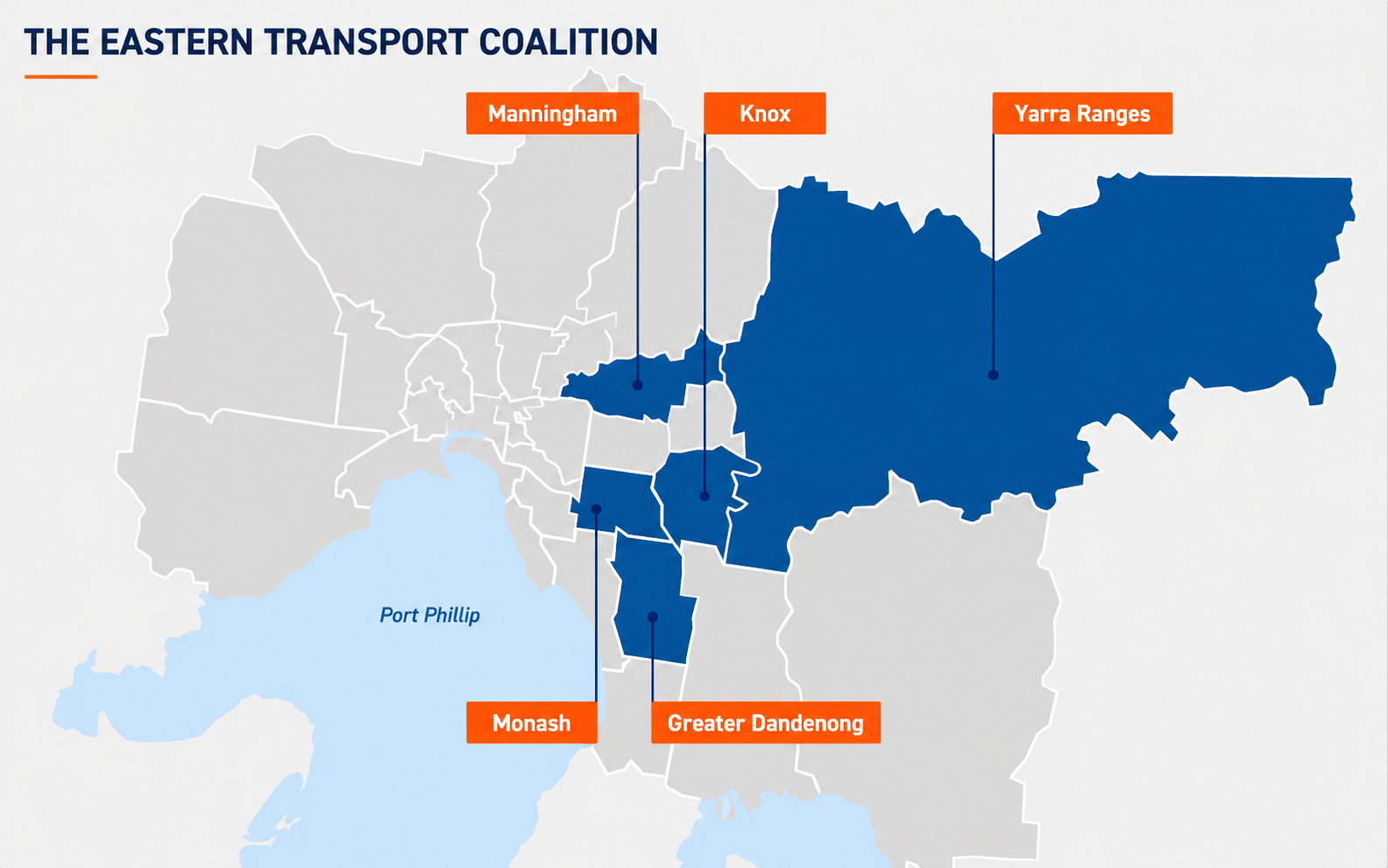
The Eastern Transport Coalition (ETC) consists of five of Melbourne’s eastern metropolitan councils.
Combined, the ETC represents approximately one million residents. We advocate for sustainable and integrated transport services that reduce car dependency.
Whether you use it or not, public transportation benefits all of us. Not only does it reduce pollution and ease congestion, it provides vital connections to jobs, education and medical care for some of our most vulnerable residents.
We aim to work with Federal and State governments to ensure the economic, social and environmental wellbeing of Melbourne’s outer east.
Help us make good transport ideas a reality in Melbourne’s east.




Duplication of the Lilydale Rail Line We are seeking a clear commitment from the State Government to duplicate the single section of rail line from Mooroolbark Station to Lilydale, and to construct a new station at Cavehill. Route 75 Tram Extension along Burwood Hwy and Mountain Hwy The ETC supports Knox City Council’s call for a feasibility and economic impact study to extend Route 75 from the Vermont South tram stop to Upper Ferntree Gully Station via Burwood Hwy and Bayswater Business Precinct via Mountain Hwy. Caulfield – Rowville Trackless Rapid Transit (TRT) The ETC is seeking the State Government to strike agreement with the Federal Government to announce funding for a business case for the Caulfield-Rowville Trackless Rapid Transit (TRT) project.
Pedestrian Crossings A number of priority upgrades to safer pedestrian operated crossing points have been identified across the municipalities in the east which will improve pedestrian safety, increase the natural catchment areas for public transport and improve traffic flow. Trails Melbourne’s eastern trail network supports local and regional economic development, local connections, sustainability, and improved safety. Key projects include: 1. Box Hill Rail Trail 2. Main Yarra Trail 3. Ringwood to Croydon Rail Trail 4. Waverley Rail Trail 5. Yarra Valley Trail 6. Ferny Creek Trail
Our road network is fundamental to providing a safe and efficient platform for our bus and tram networks and for active transport users – pedestrians and cyclists. With this in mind we have identified a number of road projects that will provide a safer route for cyclists and pedestrians, through improved intersection signals and controls, and road works that will allow for safer bus movements around bus stops and turning points at key intersections.
Growth is changing urban land use composition and activity, creating new industrial, commercial, medical, education and residential developments often without access to adequate bus routes. Increasingly, the bus network can’t take people directly and easily to access jobs, study, shops or services. The main issues to be tackled: 1. Limited or no bus services to major employment, medical, education, sport venues and residential developments. 2. Convoluted and indirect bus routes with long travel times. 3. Multiple routes servicing the same key destinations 4. Poor integrations with train services/timetables and active transport networks. 5. Extensive traffic and parking congestion into and within precincts and around regional venues. In response, the ETC has put forward informed suggestions for On demand/FlexiRide services, route realignments and extensions, new services and supporting infrastructure and road improvements.
Get in touch with us to learn how you can support better transport outcomes for your community.